— Jed Distler,
Gramophone
|
— Jed Distler,
Gramophone
|
"...he revealed...a command of the large-scale integration of structure which was indeed profound, the more so when allied to a comprehensive technique that, frankly, has everything: warmth and depth of tone, clarity and a superb colour range, precision and range of dynamics from the fullest sound to the most finely-balanced nuance - all subsumed in a reading of compelling artistry." Read More...— Robert Matthew-Walker (Editor, Musical Opinion Quarterly),
Classical Source
|
"...notable habilidad e imaginación, plena de poesía exquisita y virtuosismo emocionante, totalmente puestos al servicio del compositor." Read More...— Robert Matthew-Walker (Editor, Musical Opinion Quarterly),
Classical Source
|
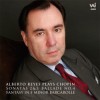
"...his integrity and spontaneous flow are unassailable and coupled with a sure structural grasp. This Chopin never wanders, but is instead sublimely guided and feels entirely authentic." Read More...— Colin Clarke,
International Piano
|
Here's a fascinating and extremely beautiful Chopin recital from a pianist of whom we've heard little in the past decades. Uruguayan born Alberto Reyes presents both the big sonatas and some substantial shorter pieces in accounts that are unusual, personal and deeply rewarding.
(Traducción al español en Read more... ) Read More...— Jessica Duchen,
BBC Music Magazine
|
What made Alberto Reyes's piano recital ...so exciting was the Uruguayan pianist's way of capturing each work's essence - the quality of its nervous energy, its musical fingerprint - and his ability to transform it into something like a living organism
(Traducción al español en Read More...) Read More...— Allan Kozinn,
The New York Times
|
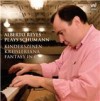
Reyes's full-bodied, colourful sonority, effortless technical apparatus, keen contrapuntal prowess and innate grasp of Schumann's mercurial idiom do rewarding justice to these oft-recorded works. Read More...
— Jed Distler,
Gramophone
|
Stylistically speaking, there's a great deal in Reyes's playing that harks back to the 'grand manner'. His sound is unapologetically round and luxurious and, once launched, his beautiful cantabile soars in an infallible arc. Tempos tend toward the spacious and sections are vividly contrasted. The overarching sweep of a work's formal structure is emphasized above focus on detail. Asynchronicity of the hands and broken chords occasionally serve to clarify polyphony or heighten expressive nuance but always within the realm of good taste. Above all, in each work there is an incontestable point of view, an expressive intent devoid of any ambiguity, that lends these disarmingly direct readings their singular authority.
(Traducción al español en Read More...) Read More...— Patrick Rucker,
International Record Review
|
"Uruguayan pianist Reyes...gives us what is close to being a definitive reading of these works, no easy task and one that I do not utter lightly" Read More...— Steven E. Ritter,
Fanfare
|
...flawless technique and the narrative instincts of the born raconteur... Read More...— Adrian Corleonis,
Fanfare
|
...a highly enjoyable concert by a musician who clearly hearkens back to the Golden Age of piano playing in the Romantic tradition Read More...— Colin Clarke,
Seen and Heard International
|
"Coming on the heels of his excellent Chopin recital, also on VAI, his interpretations here are rich, temperate and deeply expressive" Read More...— Peter Burwasser,
Fanfare
|
— Alan Becker,
American Record Guide
|
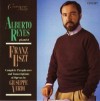
Reyes is obviously up to all the virtuoso demands, but does not flaunt his abilities. Instead he takes the music seriously, maintains a singing line with little effort, and extracts both the essence and the full impact of Liszt's treatment Read More...
— Donald Manildi,
American Record Guide
|
Reyes nos ofrece un Liszt cantabile..., virtuoso..., y profundo Read More...— S.M.B.,
Revista Scherzo, Madrid
|
"...deeply personal, imaginative, straight from the heart, and reminiscent of the grand manner of a bygone era" Read More...
— Patrick Rucker,
Fanfare
|
...rich, deliberate and supremely lyrical playing" Read More...
— Peter Burwasser,
Fanfare
|
The final pages of the Fourth Ballade are as magisterial and lucid as you could wish and in the central Elysium of the Second Sonata's Funeral March Reyes relaxes into a moving and personal eloquence. Read More...
— Bryce Morrison,
Gramophone
|
Alberto Reyes produces a singing line and judges tempos to near perfection Read More...
— Marius Dawn,
Pianist
|
...a major talent blessed with a world-class technique. Read More...— Eric Dawson,
Calgary Herald, Canada
|
What we have here is richly toned, thoughtfully paced, and honestly referential music-making. I have used the analogy before; forgive me if this reveals a weakness, but the Chopin of Reyes is the bottle of wine I can curl up with for an evening, as opposed to that splashy, high-octane Napa Valley cab that knocks you out too early on. The more I hear Reyes, the more I find some insightful moment, a thoughtful repose, or, most significantly, a sense of a coherent overall vision. Combine this clutch of attributes with splendid recorded sound, and you have a Chopin release of special merit.
(Traducción al español en Read More...) Read More...— Peter Burwasser,
Fanfare
|
His ability to breathe new life into these works is his strength. It is hearing the freshness of youth coupled with the experience of life that so impresses here. It also makes him rather difficult to classify for comparison purposes. Sometimes Bolet springs to mind in the combination of freedom with a mastery of multiple voicing, but Reyes occupies, in essence, a space all of his own. How very refreshing.
(Traducción al español en Read More...)
Read More...
— Colin Clarke,
Fanfare
|
...el pianista hilvana los pasajes consiguiendo unidad en las obras que interpreta mediante un enfoque rico en emociones y nítido en cuanto a matices. El intérprete canta con concentrada expresión y aporta fuerza y ardor a las partituras, en lo que es un Chopin vivo y sensible que prima la poética del sonido. Read More...
— Emili Blasco,
Revista Scherzo de Madrid
|
Alberto Reyes tiene a su favor la brillantez del toque, la claridad de sonido y la transparencia con que desentraña la textura melancólica, reflexiva y permanente de la música de Chopin Read More...— Alberto González Lapuente,
ABC Madrid
|
Review from the 1970 Tchaikovsky Competition in Moscow
Alberto Reyes turned out to be a genuine musician. In Mozart he showed his personal lyricism and brilliant technique. In Rachmaninoff and Chopin, Reyes demonstrated that he is performer with a particular style, capable of transporting the listener to a world of fantastic musical imagery. Finally, his Tchaikovsky scintillated with genuinely Russian colors. — Novosty Agency, Moscow, U.S.S.R
|
Review from orchestral debut at Avery Fisher Hall, New York, 1974
From a purely musical point of view, the best performance of the day came from Alberto Reyes, soloist in Mozart's Piano Concerto No. 23 in A (K. 488). ...in his debut here, (he) delivered a nicely musical account of his part, lapsing into neither flashy excess nor self-effacing plainness. — John Rockwell,
The New York Times
|
His playing breathed poetry; there was enough color for an orchestra. He does not exploit the piano for the sake of technique display, rather uses it to draw life from those little black dots on the page. Read More...— Michael Donaldson,
Washington Star-News, Washington, D.C.
|
Prokofieff's Concerto Nº 2 in G Minor, California
Alberto Reyes raised a surprising arch of passion in a work that made the most sustained technical demands, Prokofiev's Concerto No. 2 in G minor. It was a job of high prowess, showing supple responsiveness to Prokofiev's lyricism and a highly intelligent grasp of the internal balances. — San Francisco Chronicle
|
Excerpt from Montevideo recital
Hay en Reyes un raro equilibrio entre la inteligencia y la sensibilidad. Frente a esa suma de excelencias, hablar del mecanismo de Reyes parece obviamente innecesario. Quien se desenvuelve a nivel internacional como lo hace él no puede competir con medios por debajo de lo brillante. No toca, sin embargo, como un virtuoso sino como un músico; como un músico personal, que no deja que los moldes lo asfixien y que logra expresarse por sí mismo a un nivel excepcionalmente rico y sugerente — Washington Roldán,
El País, Montevideo, Uruguay
|